The delivery file
How copper crosses skin
The most useful experiment in this file follows copper through separated skin layers.
Human skin outside the body
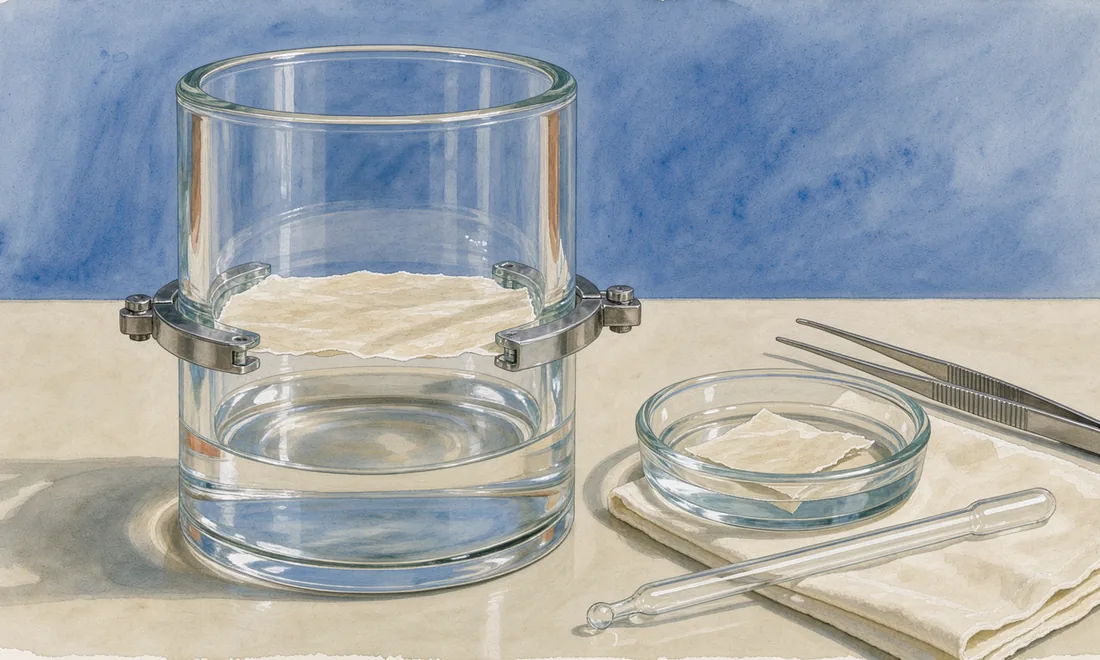
The skin-penetration study examined human skin ex vivo and in vitro, by skin layer. Ex vivo means tissue studied outside the body. Copper was applied as the GHK-Cu tripeptide, and the experiment followed the copper.
Over 48 hours, copper permeated dermatomed skin and was also retained as a dermal depot. The finding gives a concrete meaning to local delivery: the measured material crossed the tested skin preparation, while some remained within it.
The retained fraction makes the skin itself a destination. A familiar aesthetic story would hurry straight from application to a visible improvement. This experiment spends its attention on the material's whereabouts, and the result is useful on those terms.
The peptide and its carrier
The topical GHK review identifies poor stratum-corneum permeability as a central problem. The stratum corneum is the outer skin barrier. That obstacle is part of the reason the review examines altered forms and delivery approaches, including palmitoylation and microneedle pretreatment in the experiments it discusses.
Palmitoylation attaches a fatty component to the peptide. The review considers Pal-GHK as one way to change its delivery properties. Those formulation experiments have a different subject from the simple question of whether GHK can affect a cultured cell.
I give the carrier considerable credit here. It is easy to become attached to a short molecule name and let the material around it disappear from the story. Yet a formulation has to get its contents somewhere useful. The peptide's name alone cannot describe that journey.
Copper measured in the skin
The penetration experiment quantified copper delivery and retention. I take care with that noun. The experiment offers a copper result in a tested skin preparation; it leaves the fate of an intact peptide throughout a living person outside the account given here.
That boundary sharpens my interest. There is enough substance in a local depot to discuss without dressing it as a whole-body effect. It also gives the cosmetic question a sensible place to begin: the tissue where a local change is being sought.
For anyone following the archive in order, this is where the apparently simple phrase ‘applied to skin’ becomes physically complicated. The cosmetic file deals with measured outcomes in subjects. This file stays with passage and retention, which are worthwhile subjects before an appearance claim is made.